
When to turn it on
The honest answer is that there's no fixed date. Your sprinklers should come back on after the last hard freeze of the season, and that moves around every year. In Colleyville, the last freeze usually lands in mid-March. But a hard freeze can still surprise us into April. So the calendar is a guide, not a rule. The forecast is the rule.
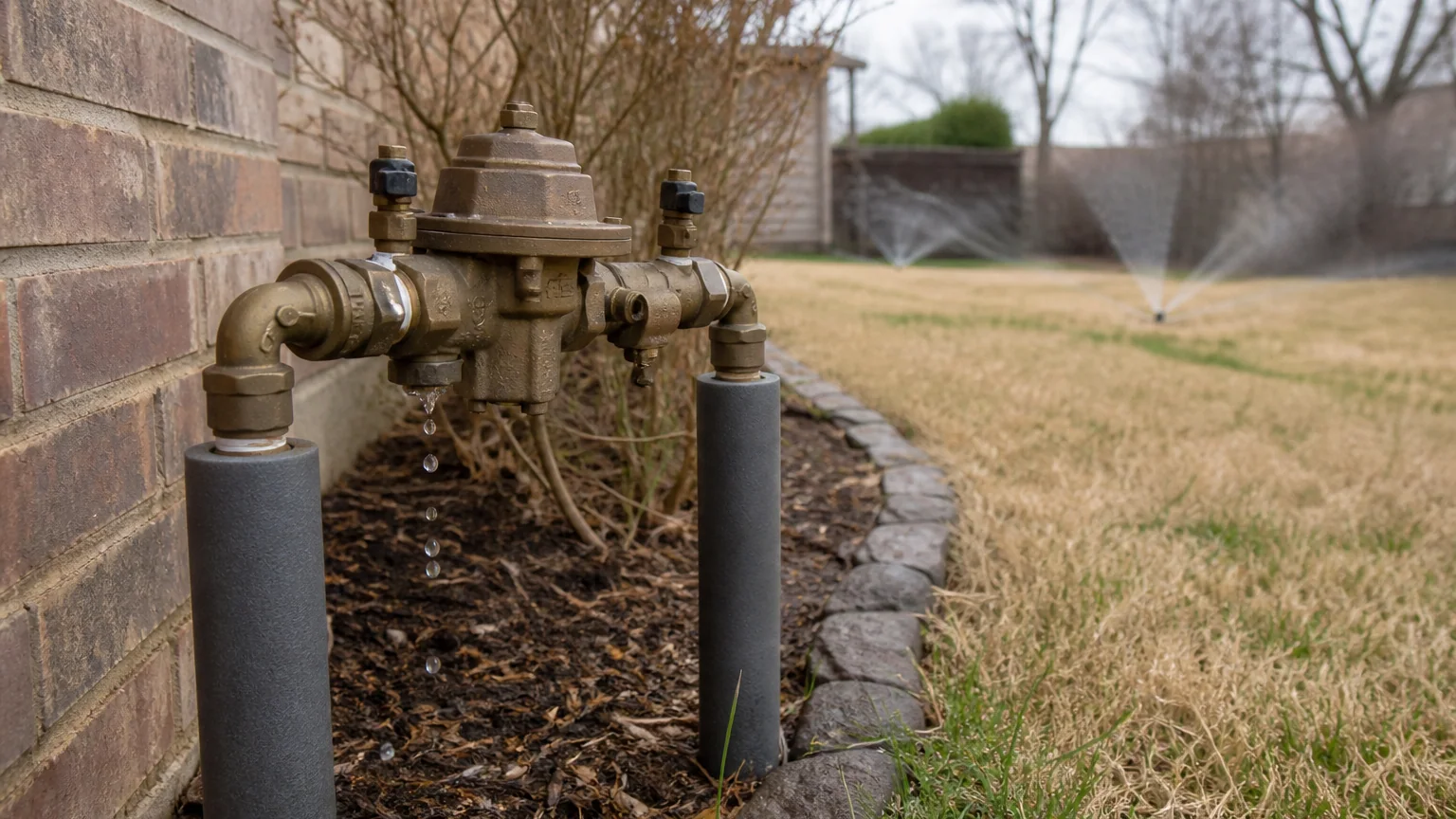
The reason to wait is simple. Once you open the main valve, the pipes and the parts above ground fill with water. Water that sits in a line during a freeze expands as it turns to ice, and that's what cracks pipes and splits sprinkler heads. The part most at risk is the backflow preventer up near the house — it sits above ground, exposed, and it's the first thing a freeze gets to. Turn the system on a week too early, catch one more cold night, and you can undo the whole point of having winterized it.
So before you start it up, check the ten-day forecast. If there's no hard freeze coming, you're clear. If a cold front is on the way, give it another week. There's no cost to waiting — a dormant March lawn isn't asking for water yet.
Why you start it up slowly
Here's the move most people get wrong: they walk out, crank the main valve wide open, and let every zone fire at once. After months of sitting empty, that's hard on the system. A wall of water slamming into dry pipes — plumbers call it water hammer — can blow apart fittings and crack heads that froze brittle over winter. And with every zone running at once, you can't actually see what's wrong.
The better way takes ten extra minutes. Open the main valve slowly, just a little at a time, so the lines fill with water gently and the air pushes out instead of getting trapped. Then run the zones one at a time, and stand there and watch each one. That slow start-up isn't busywork. It's the single best inspection you'll do all year, because winter damage only shows itself when the water's on and you're looking.
Spring sprinkler start-up, step by step
Once the freeze risk has passed, here's the order that catches problems instead of creating them:
- Check the forecast first. No hard freeze in the ten-day. If one's coming, wait.
- Find the main valve. It's usually a handle on the pipe near the backflow preventer by the house — the brass or plastic assembly that sticks up out of the ground. On some systems the valve sits in a small in-ground box instead, under a green or black lid set flush with the lawn. A lever-style valve is on when the handle lines up with the pipe; a round-handle valve opens counterclockwise (lefty-loosey).
- Open it slowly. Crack the valve open a little at a time over a minute or two, so the lines fill with water gently instead of slamming full. You want to hear the lines fill, not bang. The air in the empty lines pushes out through the heads as the zones run.
- Look over the backflow preventer. Check that above-ground assembly for cracks, drips, or a steady spray. Freeze damage shows up here first.
- Run each zone, one at a time, from the controller — the timer box, usually mounted in the garage. Most controllers have a "manual" or "test" setting that runs one zone on demand; use that to step through them, a minute or two each, and watch every head.
- Watch for the trouble signs (the next section lists them). Note any zone that looks off before moving to the next one.
- Reset the controller for spring. Set a light early-season schedule, and plan to dial it up as the heat comes. Don't crank the runtime to summer levels in March.
Done in that order, you either confirm the system came through winter fine, or you find the one thing that didn't, while it's still a small fix.
Can't find the main valve, or you open it and nothing runs anywhere? Don't force anything. That's a good point to call rather than guess — our irrigation services team can locate the valve, find the problem, and get the system running.
What freeze damage looks like
As each zone runs, you're looking for a handful of tells. Catch them now and they're a quick repair. Miss them and the system keeps wasting water until a brown patch finally tips you off in summer.
- A head that won't pop up, leans over, or sprays off to the side. Freeze and soil movement knock heads loose or crack the stem the head sits on.
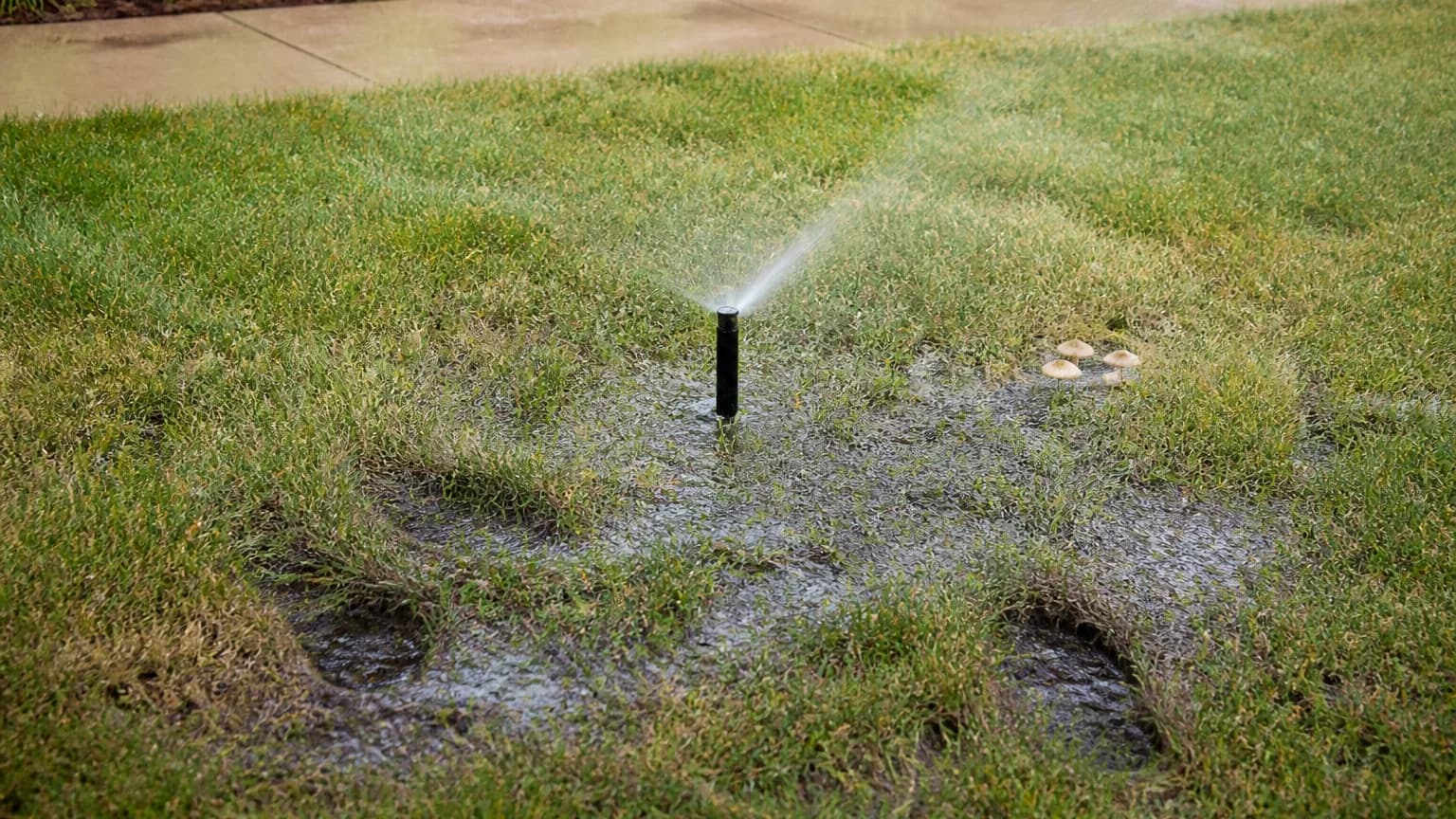
- Ground that puddles or bubbles up when a zone runs. Water surfacing where it shouldn't usually means a cracked line or a split fitting below it.
- A zone that won't come on at all. Often a valve or a wiring problem rather than the pipe — still worth tracking down.
- A zone that runs weak. Low pressure on one zone can point to a leak somewhere along that line.
- Drips or a spray at the backflow preventer. A cracked backflow assembly leaks at the top. It's required by plumbing code, and it's the most common freeze casualty here.
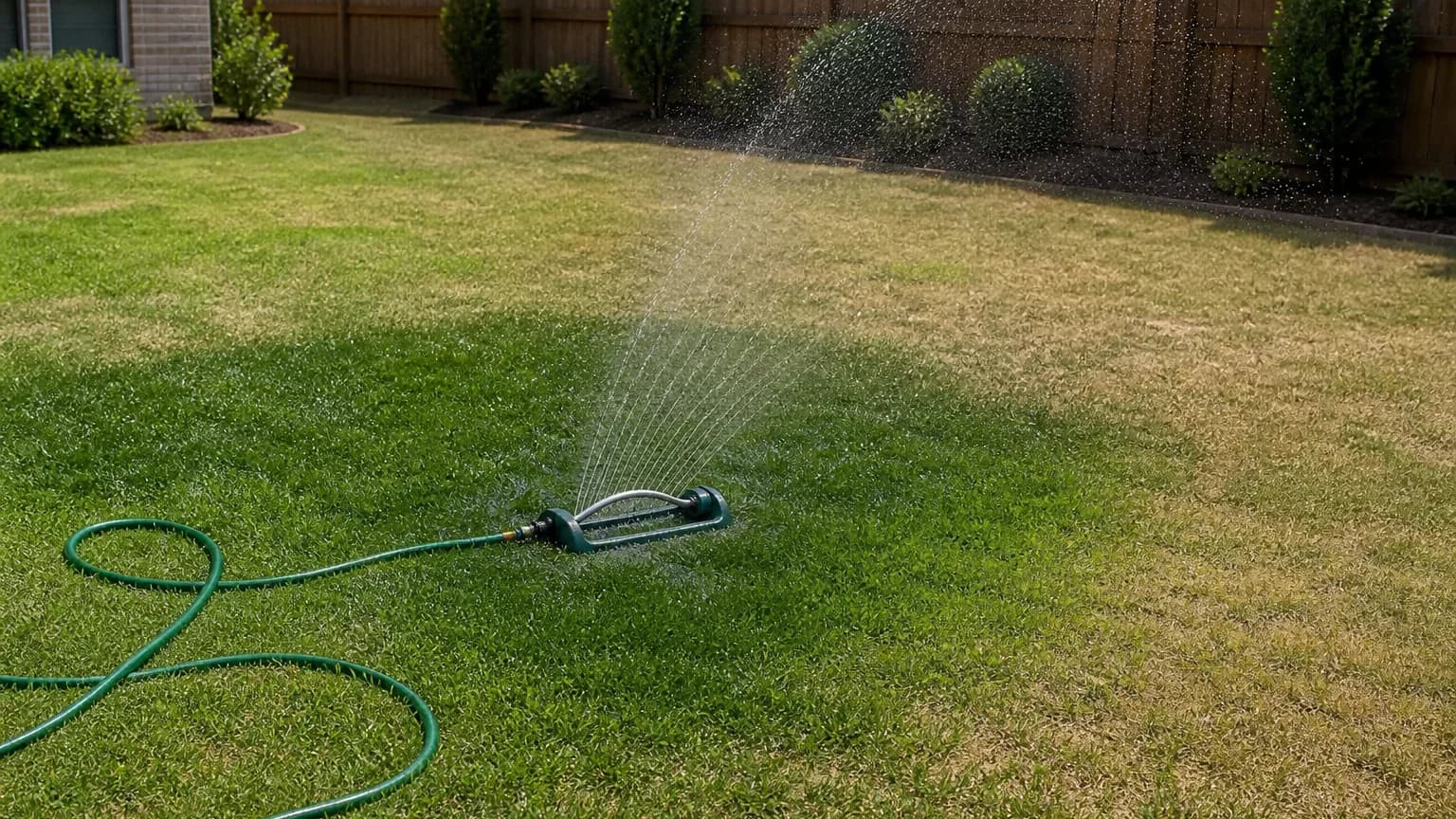
A working system waters evenly, with every head popping up and laying water down where it should. Anything short of that is worth fixing before you rely on it through the summer.
What makes the timing tricky in North Texas
Spring sprinkler advice written for the whole country sets you up to turn the system on too early here. A few North Texas realities change the call:
- The late freeze is real. Our last freeze usually lands in mid-March, but a hard freeze has hit as late as mid-April. That long tail is exactly why you wait on the forecast instead of a date on the calendar.
- Watering restrictions kick in for the season. Many DFW cities limit lawn watering to set days, and sometimes set hours, once spring arrives. Worth checking your city's current rules before you build the spring schedule, so the system runs on an allowed day.
- Clay soil takes water slowly. Our heavy clay can't take a long, heavy watering. It just runs off. Shorter cycles that let the water sink in beat one long run. Keep that in mind when you set the spring schedule.
- Don't confuse "tested" with "needed." Spring here is often wet. You can start the system, confirm it works, and still leave it off for a few weeks while the rain does the watering. Running it on a timer through a rainy spring is the easy way to over-water early.
Once the system is back on, the bigger seasonal mistake is watering too much, not too little. Our guide on watering too much covers how to water deep and skip the days you don't need.
When to hand it off
Turning the system on and walking the zones is a fair job for most homeowners. A few parts are better handed off:
- You found freeze damage. A cracked line, a split head, or a leaking backflow part is a repair, and chasing a hidden underground leak takes the right tools. That's what our irrigation services team does.
- The backflow preventer needs testing. Many cities require a licensed test on the backflow preventer, and they want the paperwork filed. That's not a DIY job. We refer that licensed test out.
- A zone is dead and you can't find why. A zone that won't come on can be a valve, the wiring, or the controller. Tracing it is faster for someone who does it daily.
- You'd rather it just be handled. A spring start-up, a coverage check, and the schedule set right is something we do as a service. We also handle the fall shutdown before the first freeze, so the system is protected for next winter.
Want your system started, checked, and tuned for the season — or fixed if winter got to it? Get a free quote or call (817) 701-8920.