
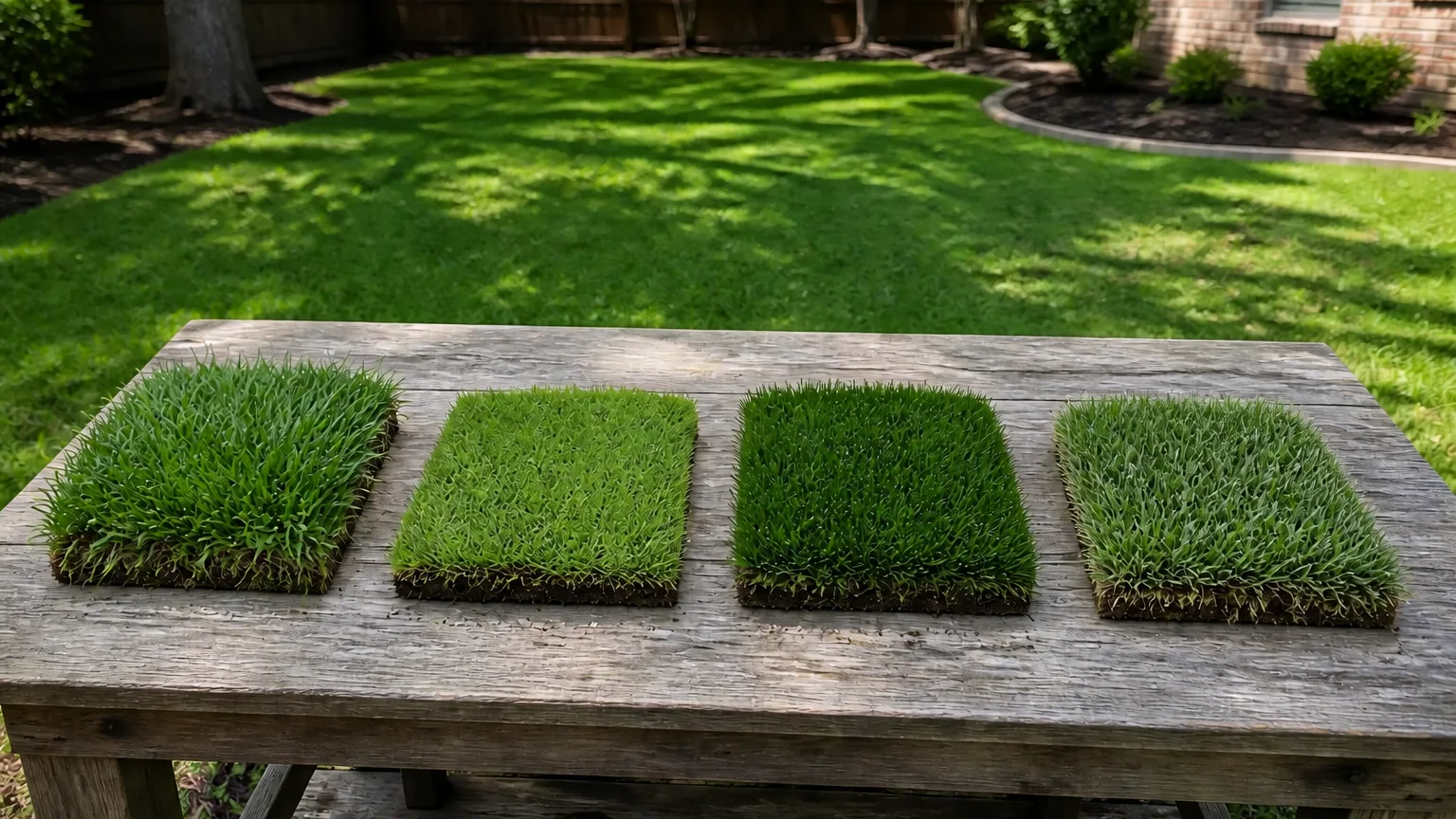
Start here: what actually decides your grass
Before you look at any grass, look at your yard. Four things matter most:
- Sun. Count the hours of direct sun the lawn gets. Full sun is six hours or more. Partial shade is four to six. Deep shade is under four. This is the biggest factor by far. Not sure how much you get? On a clear day, check the spot at 9 a.m., noon, and late afternoon, and add up the hours it sits in direct sun. Go by the shadiest part of the lawn — that's the part that decides.
- Traffic. Kids, dogs, and weekend games wear a lawn down. Some grasses heal fast. Some don't.
- Water. Do you have a sprinkler system, or are you dragging a hose? Some grasses sip; some drink.
- Effort. How much mowing, feeding, and fussing are you up for? Be honest with yourself here.
Answer those four and the list shrinks fast. The same grass that's perfect for one house is wrong for the house next door if the yards face different directions.
The 8 best grass types for Colleyville
1. Common Bermuda
The most planted grass in Colleyville, and for good reason. It loves full sun, shrugs off heat, and heals quickly when the dog tears up a patch. It's also the cheapest to put in.
- Sun: full sun (six-plus hours)
- Traffic: excellent
- Water: moderate; drought-tough once rooted
- Mow height: 1.5 to 2.5 inches
- Best for: full-sun yards, busy families, tighter budgets
The catch: Bermuda spreads hard. The same runners that heal a worn spot also creep into your flower beds. It needs regular edging, it thins out fast under shade, and it browns earlier and longer through winter than St. Augustine or Zoysia.
2. Hybrid Bermuda (Tifway 419, Celebration)
The premium version of Bermuda. Finer blades, denser growth, deeper color. Same love of sun and heat. This is the "golf-course look" grass.
- Sun: full sun
- Traffic: excellent
- Water: moderate
- Mow height: 0.75 to 1.5 inches
- Best for: premium full-sun lawns, sports use, a manicured look
The trade-off: it only comes as sod or sprigs, never seed, so it costs more up front. It also wants more frequent, lower mowing to look its best.
3. St. Augustine (Raleigh)
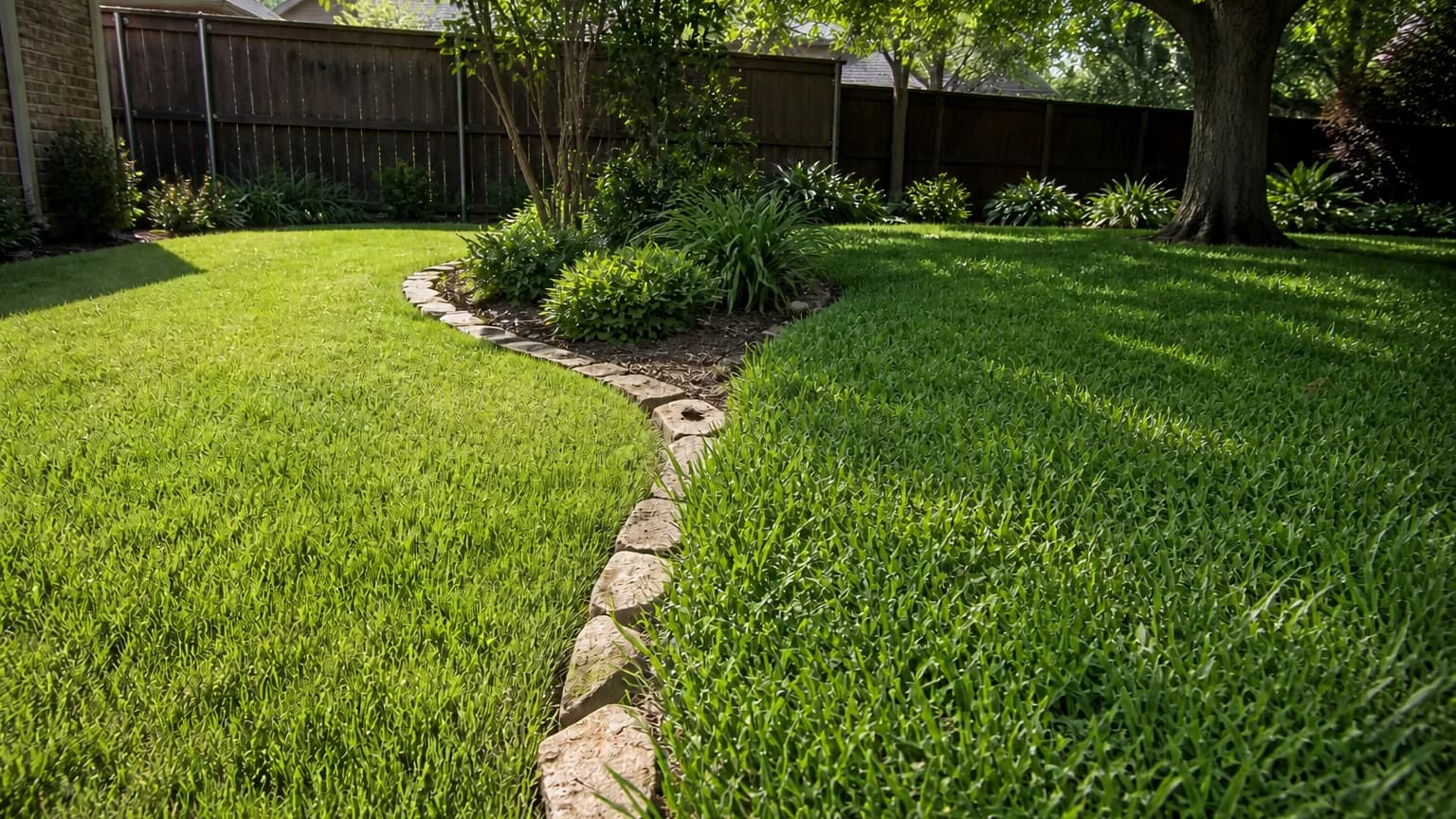
The second most common grass here, and the go-to for yards with some shade. It grows into a thick, blue-green carpet that feels good underfoot.
- Sun: full sun to some shade (five-plus hours)
- Traffic: moderate
- Water: higher than Bermuda
- Mow height: 3 to 4 inches
- Best for: lightly shaded yards, homeowners who want looks over toughness
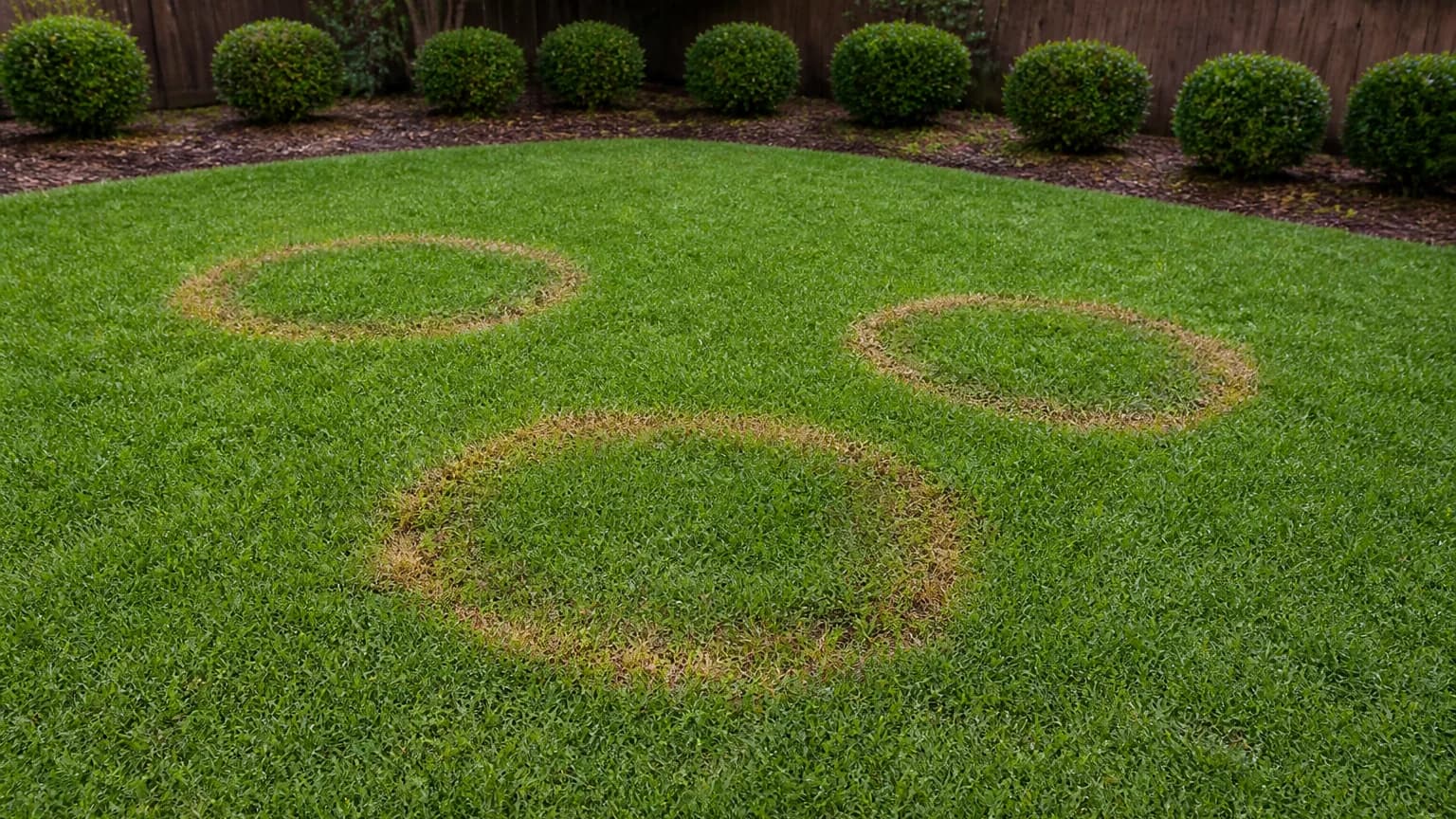
The catch: it wants more sun than people expect, it doesn't love heavy traffic, it drinks more water, and it's the grass most likely to get brown patch fungus in our humid stretches. (Our guide on brown patches in your lawn covers what that looks like and how to treat it.)
4. Palmetto St. Augustine
A St. Augustine bred to handle shade, cold, and drought better than Raleigh. If you want the St. Augustine carpet but your yard is shadier or your winters worry you, this is the pick.
- Sun: full sun to moderate shade (four-plus hours)
- Traffic: moderate
- Water: moderate
- Mow height: 2.5 to 4 inches
- Best for: shaded yards that still want a lush look
The downside: it costs more than standard St. Augustine. For a yard under a lot of tree canopy, the extra shade tolerance is usually worth it.
5. Zoysia (Empire, Palisades)
The densest, most carpet-like grass you can plant here. It takes more shade than Bermuda, more traffic than St. Augustine, and stays green later into fall than either.
- Sun: full sun to partial shade (five-plus hours)
- Traffic: good to excellent
- Water: moderate; drought-tough once rooted
- Mow height: 1.5 to 2.5 inches
- Best for: homeowners who want the best-looking, best-feeling lawn
The catch: it's the slowest to fill in and the priciest sod on this list. It grows slowly, which means less mowing once it's in, but slow recovery if it gets torn up.
6. Buffalo Grass
A true Texas native and one of the most drought-proof lawns you can grow. It makes a fine, soft, blue-green turf on a fraction of the water and feeding other grasses need.
- Sun: full sun
- Traffic: light to moderate
- Water: very low
- Mow height: 2 to 4 inches (some leave it unmowed)
- Best for: low-water yards, low-effort owners, natural and drought-tolerant designs
Where it falls short: it can't take heavy play, and it doesn't like shade. For the right low-key yard, though, it gives you a real living lawn with almost no upkeep.
7. Tall Fescue (the cool-season option)
The one grass here that stays green through winter while the others go brown and dormant. It's a cool-season grass, so it's happiest in spring and fall.
- Sun: full sun to partial shade
- Traffic: good
- Water: higher in summer
- Mow height: 3 to 4 inches
- Best for: winter green, or shady yards too dark for warm-season grass
The catch: our summers are hard on it. Expect more water in the heat and some thinning in the worst weeks. It's a niche pick, but a good one for deep shade or for owners who can't stand a brown winter lawn.
8. Artificial Turf (the modern alternative)
Not grass, but a real answer for some yards. Today's artificial turf looks far better than the plastic stuff of the past, with mixed-tone fibers and a real drainage layer underneath.
- Sun: any
- Traffic: excellent
- Water: none
- Mowing: none
- Best for: heavy pet zones, deep shade, spots where real grass keeps dying
The trade-off: it costs more to install, and it gets hotter than grass in full sun. For a worn-out pet run or a shady strip where nothing grows, it ends the fight for good.
Grass type at a glance
| Grass type | Sun needs | Drought tolerance | Traffic tolerance | Upkeep | Best for |
|---|---|---|---|---|---|
| Common Bermuda | Full sun | Excellent | Excellent | Moderate | Full-sun budget lawns |
| Hybrid Bermuda | Full sun | Excellent | Excellent | High | Premium full-sun lawns |
| St. Augustine (Raleigh) | Sun to part shade | Moderate | Moderate | Moderate–high | Shadier, looks-first yards |
| Palmetto St. Augustine | Sun to part shade | Good | Moderate | Moderate | Shaded yards needing resilience |
| Zoysia | Full sun to part shade | Good | Good–excellent | Low–moderate | Premium, dense lawns |
| Buffalo grass | Full sun | Excellent | Light–moderate | Very low | Low-water, low-effort yards |
| Tall fescue | Sun to shade | Moderate | Good | Moderate–high | Winter color, deep shade |
| Artificial turf | Any | N/A | Excellent | Minimal | Heavy pets, deep shade, failed turf |
A quick word on cost
Cost often breaks a tie, so here's the rough order. Cheapest to priciest to install: seeded common Bermuda or Buffalo grass, then common Bermuda sod, then St. Augustine, then Palmetto and hybrid Bermuda, with Zoysia the priciest sod. Artificial turf costs the most up front — but you never water or mow it again, so it can pay back over the years.
One more cost note: sod costs more than seed, but you get a finished lawn the day it goes down instead of waiting a full season for seed to fill in.
Got a yard that's sunny in front and shaded in back? You don't have to force one grass to do everything. Plenty of homeowners run Bermuda in the bright front yard and St. Augustine under the backyard trees, with a clean edge or a bed between them.
Bermuda or St. Augustine? Zoysia or Bermuda?
Most Colleyville yards come down to one of two calls.
- Bermuda vs. St. Augustine is the everyday one. Go Bermuda for full sun and heavy use — it's tougher, cheaper, and faster to heal. Go St. Augustine if part of the yard is shaded and you care more about a thick, soft look than wear.
- Zoysia vs. Bermuda is the premium one. Both want plenty of sun. Pick Zoysia for a denser feel, less mowing, and a little shade tolerance. Pick hybrid Bermuda for the brightest green, fast recovery, and active use.
Narrowed it to Zoysia or St. Augustine? Our Zoysia vs. St. Augustine guide puts them head to head for North Texas yards.
What makes a Colleyville yard tricky
A few North Texas facts shape every grass choice here.
Our soil is clay. It holds water after a storm and then bakes hard and cracks in the heat. New grass roots struggle in raw clay, so good soil prep — working compost into the top few inches before sod goes down — matters as much as the grass you pick.
Our summers are long and brutal, and our winters are short and mild. Warm-season grasses (Bermuda, St. Augustine, Zoysia, Buffalo) love the heat and go brown and dormant after the first hard freeze. That brown is normal, not dead. (If you're not sure which it is, our brown-patch guide has the simple tug test.)
Shade is the other big one. Mature oaks and pecans are part of what makes these neighborhoods feel established, but they steal sun from the lawn below. Under heavy canopy, Bermuda thins out within a couple of seasons. That's where St. Augustine, Palmetto, or Zoysia earn their keep.
One more local thing worth a look: your HOA. Some Colleyville-area neighborhoods restrict artificial turf in front yards, or require lawns to be kept mowed and green. Check your guidelines before you commit to a grass — or to turf.
Planning a new lawn? Where a pro helps
You can pick a grass on your own with the list above. Where it pays to bring in help is the install, because that's the part you don't get to redo cheaply.
- The grass you want only comes as sod. Hybrid Bermuda, St. Augustine, and Zoysia are sod-only. Common Bermuda, Buffalo grass, and fescue can also be seeded — though Bermuda and Buffalo are often sodded anyway for a faster, weed-free start. Getting sod laid and rooted right is the difference between a lawn that takes and one that struggles from year one. (Our sod installation guide walks through the process.)
- Your yard has more than one condition. Sunny front, shaded back, a worn pet zone — a pro can lay out which grass goes where instead of forcing one to cover all of it.
- You want it done once, done right. Soil prep, timing the install for the growing season, and the first-year care that locks a new lawn in are easy to get wrong. A new lawn needs daily water for the first two weeks, then a slow taper. Hold off on weed control until year two, when the grass can take it — see our pre-emergent timing guide.
A sod installer handles that end to end: reading the yard, sourcing the grass, prepping the soil, and laying it. Where we fit is the eighth option. When one part of the yard keeps losing whatever you plant there, artificial turf is the honest answer, and installing it is our work. Tired of that corner? Get a free quote.